
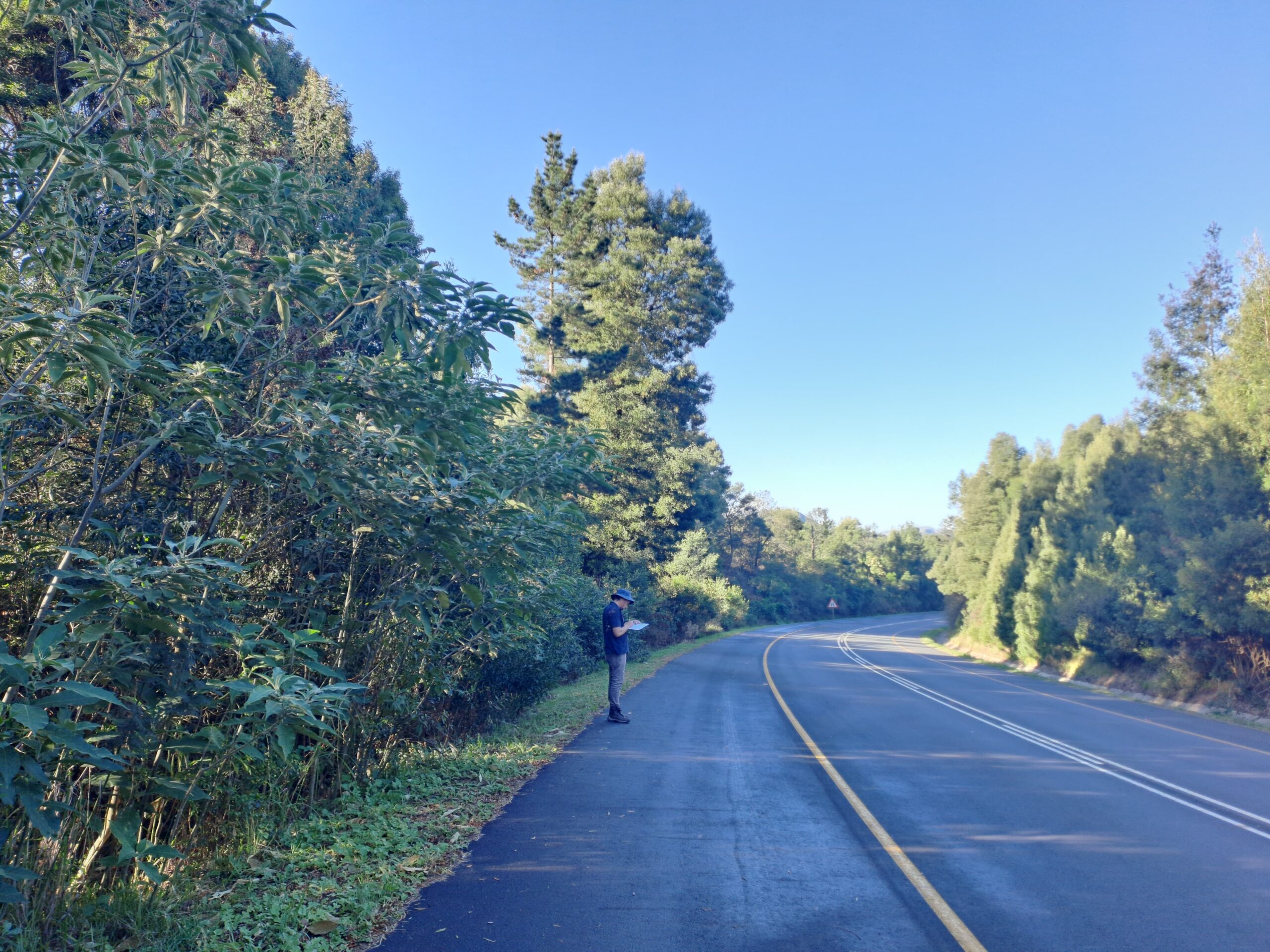
Background to invasive alien species assessments
Since 2024, Apex has completed two separate invasive alien species (IAS) assessments, and is currently busy with a third, for the South African National Roads Agency (SANRAL). Apex was subcontracted by two companies on behalf of SANRAL: Masututsa Consulting and Lathiso Consulting Engineers. These projects guide the client on controlling IAS on the properties to ensure legislative compliance. Each of these three projects include the following components:
- Assessment of IAS within SANRAL’s properties and the compilation of an IAS inventory
- The development of an IAS Monitoring, Control and Eradication Plan (IASMC&EP)
- Development of an Environmental Management Plan (EMP)

Invasive alien species assessments
The Apex team surveyed numerous properties and sites over large extents for each project, including:
- Project 1: 261 properties and nine fire breaks spanning from Nature’s Valley to Groot Brakrivier in the Western Cape, representing 640 ha.
- Project 2: 30 properties and two firebreaks spanning from Groot Brakrivier to west of Heidelberg in the Western Cape, representing 35 hectares.
- Project 3: 463 sites in the road reserves aligned to sections of the N2, R75, and R335, in and around Gqeberha in the Eastern Cape, representing 1110 ha.
On each property, the team identified the invasive alien plants (IAPs) and collected relevant data on these species. This included information such as age class, density, habitat type, and habitat condition. We also recorded the invasive alien animal species likely to occur in these areas.

Legislative compliance
The Apex team assembled a species inventory for each project, consisting of:
- Project 1: 119 alien and IAPs and 11 invasive alien animals
- Project 2: 52 alien and IAPs and 7 invasive alien animals
- Project 3: 98 alien and IAPs and 6 invasive alien animals
Common IAPs identified in the three project extents included Acacia mearnsii (Black wattle), Acacia cyclops (Red-eyed wattle), Eucalyptus spp., Acacia saligna (Port Jackson willow), Pinus spp. (Pine), and Acacia melanoxylon (Australian blackwood).

Invasive alien species Monitoring, Control and Eradication Plan
We compiled an IASMC&EP for each project extent to ensure the client’s properties are NEM:BA compliant. The IASMC&EP summarizes information on IAS found across these properties, and describes each site and fire break. This information was used to inform the prioritization and management recommendations for these areas. The IASMC&EP outlines the workload associated with clearing the identified IAPs. Further, an estimated operational budget to undertake the clearing requirements is provided, and a planned work schedule with time frames.
Environmental Management Plan
The Apex team further prepared an EMP for these properties for SANRAL. The EMP aims to provide additional guidance on the management and implementation of the IAS control methodologies and to prevent undue or reasonably avoidable adverse impacts of the project. The EMP also helps enhance the positive benefits derived through the project. It provides comprehensive guidelines for invasive plant and animal control, biomass management, rehabilitation, and a variety of other activities associated with IAS control.

For any invasive alien species training, assessments, or the development of Monitoring, Control and Eradication Plans and Environmental Management Plans, please contact us here.
For more content on IAPs and the important work we are involved in, visit our social media pages!